

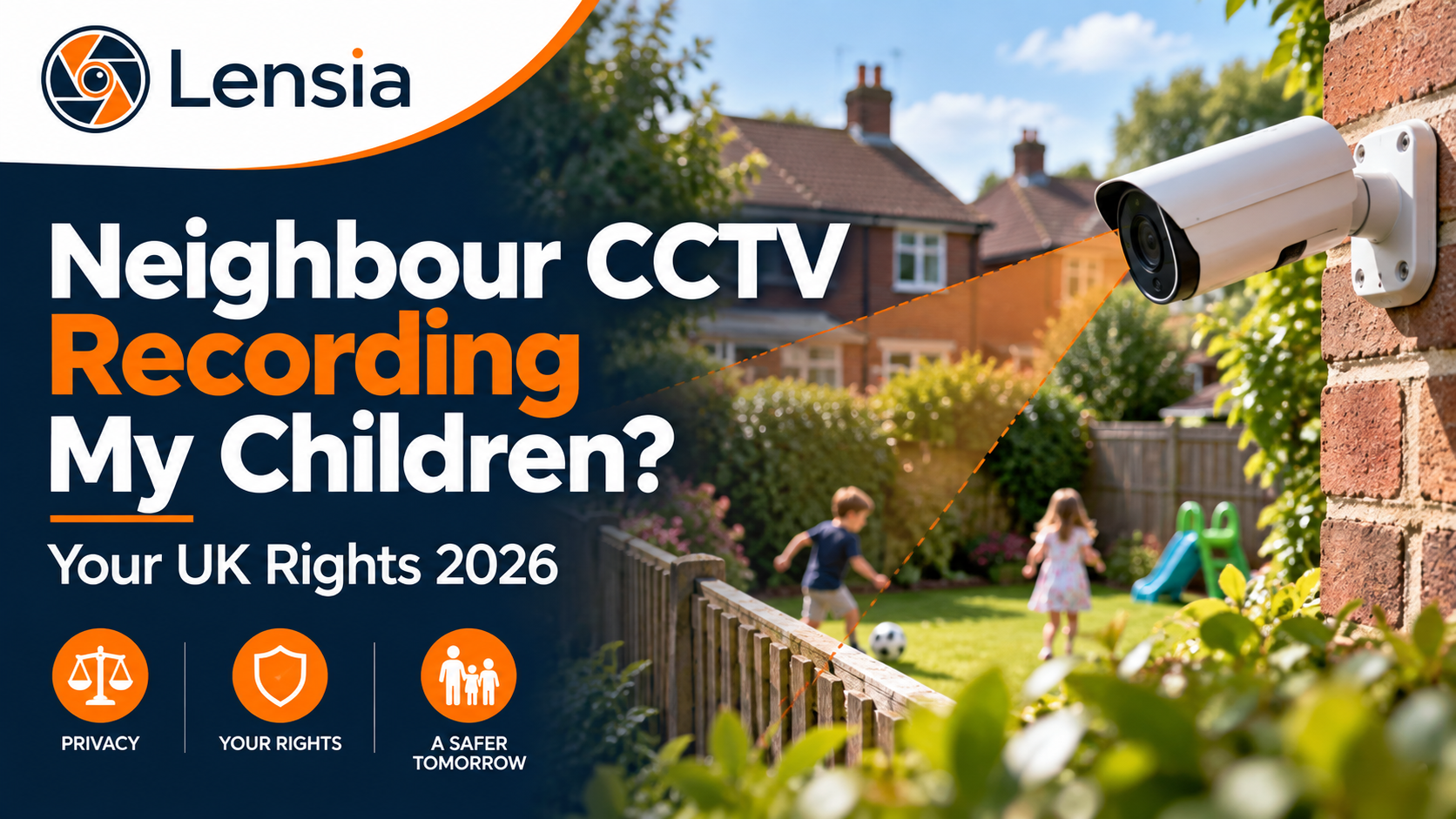

If you are worried about neighbour CCTV recording my children, the first thing to know is that a camera is not automatically unlawful simply because a child appears in the footage. The legal position usually turns on where the camera is pointing, what it records, why the recording is needed and whether it captures people outside the owner’s private property. When home CCTV reaches into your garden, driveway, shared space or the street, UK data protection rules can apply.
Quick answer
A neighbour can use CCTV for home security, and recording a child is not automatically illegal. If the camera captures people outside the neighbour’s private property boundary, however, data protection law can apply. The owner should have a clear reason for the recording, avoid capturing more than necessary, keep footage secure, delete it when it is no longer needed and respect applicable data rights. If you believe someone is recording your child inappropriately, current ICO guidance says you should contact the police.
Is neighbour CCTV recording my children legal?
There is no simple UK rule saying that domestic CCTV becomes illegal the moment it records a child. A security camera may capture children walking past a house, playing near a shared entrance or arriving at a neighbouring property without the owner doing anything unlawful.
The ICO says home CCTV owners should, where possible, position cameras so they only capture their own property. If the system records someone else’s property, a public area or a communal space, data protection law applies because identifiable images and voices can be personal information.
That is why the camera angle matters more than the fact that the person being filmed happens to be a child.
If your wider concern is the camera itself rather than children specifically, see our guide to a neighbour’s CCTV pointing at your house.
The property boundary is the key legal line
Purely domestic CCTV that stays within the owner’s private home and garden will generally fall outside the normal UK GDPR rules. Once the system captures identifiable people beyond that private boundary, the position changes.
GOV.UK guidance, updated in May 2026, says that if a domestic CCTV system captures people outside the boundary of the user’s private domestic property, the UK GDPR and Data Protection Act 2018 apply. That can include neighbouring homes and gardens, shared spaces and public areas.
The owner should be able to explain why the recording is needed, minimise what is captured, tell people CCTV is operating, keep recordings secure and delete footage when it is no longer required.
The ICO says consent will rarely be required for home CCTV. A neighbour may have a legitimate security reason for recording without asking every passer-by for permission, but that does not give them a free pass to record an unlimited area.
For homeowners who operate cameras themselves, our home CCTV rules UK guide explains the same boundary issue from the camera owner’s side.
What if the camera films children in your garden?
A camera overlooking the part of your garden where your children play deserves closer scrutiny than one that incidentally catches a child walking along the pavement.
It still does not follow that the recording is automatically illegal. The neighbour may have a genuine need to monitor a fence, gate, shed or access route close to the boundary. The question is whether the amount being recorded is reasonably connected to that purpose or whether the camera could achieve the same security aim with less intrusion.
Practical fixes may include pointing the camera lower, narrowing its detection area or applying a privacy mask that blocks part of your property.
If you cannot tell what the camera sees, ask the neighbour to show you the field of view. The ICO recommends asking what is being recorded; seeing the view may either reassure you or confirm that your garden is captured more widely than necessary.
Audio can make the intrusion more serious
Modern cameras and video doorbells often have built-in microphones. That matters because sound can reveal far more than an image alone. A camera might show a child playing in the garden; a microphone might also capture a family conversation taking place several metres away.
ICO surveillance guidance treats continuous audio recording as particularly intrusive and says sound recording should normally be disabled unless there is a clear reason for it. For a domestic system, the practical question is simple: does the owner genuinely need sound to protect the area they are securing?
If you think a neighbour’s camera is recording conversations involving your children, ask whether audio is enabled and why it is needed. Switching off the microphone may solve a large part of the problem without affecting the camera’s main security purpose.
For more detail, see our guide on CCTV audio recording law in the UK.
Your child has data protection rights too
If the neighbour’s CCTV is subject to data protection law, footage that identifies your child is your child’s personal information. The right of access belongs to the child, although a parent or guardian can often exercise that right on the child’s behalf where appropriate.
You can ask for relevant CCTV footage through a subject access request. Give a date, approximate time, location and description so the owner can find the clip. Current ICO guidance says a request can be made verbally or in writing and the normal response time is one month. In some cases the controller can take longer; the 2026 rules also allow the clock to be paused where reasonable clarification is genuinely needed.
There is a useful distinction for older children. ICO guidance says that in Scotland, a person aged 12 or over is usually presumed mature enough to exercise their own access rights unless there is evidence otherwise. England, Wales and Northern Ireland do not use the same fixed presumption; competence is assessed according to the child’s understanding.
You may also object to the recording or ask for relevant footage to be erased. Neither right is absolute. A neighbour may be able to continue recording or retain a particular clip where there is a sufficiently strong lawful reason, such as preserving evidence connected with an incident. They should still consider the request properly and explain their position.
What to do if a neighbour’s CCTV records your children
Start with the facts rather than an accusation. A camera that looks intrusive from ground level may have a narrow field of view, while a small video doorbell may record far more than expected.
- Work out what appears to be captured. Note the camera position, whether it moves, where your child is when you believe recording happens and whether a microphone may be active.
- Raise the concern with the neighbour. Ask what area is recorded and why. Explain specifically that your concern is the recording of your child or your private garden rather than the mere existence of CCTV.
- Ask for a practical change. Suggest repositioning the camera, narrowing the detection area, using a privacy mask or switching off unnecessary audio.
- Put your objection in writing if needed. Keep it factual and identify the area being recorded. Written communication also gives you a record of what you asked for and when.
- Use your child’s data rights where applicable. You can consider requesting footage, objecting to the processing or asking for deletion, depending on the circumstances.
- Escalate only if the issue remains unresolved. The ICO has a specific process for complaints about home CCTV. If the neighbour is a tenant, their landlord or housing provider may also be able to help.
GOV.UK’s general neighbour-dispute guidance follows a similar order: try to resolve the issue informally, consider the landlord or mediation where relevant, and use court action only as a last resort.
A message you can send
You do not need legal language. A straightforward note is usually better:
“Hi, I’m concerned that your CCTV appears to record the part of our property where my children spend time. Could you please confirm what area the camera records and whether audio is enabled? If our garden is being captured, would you be able to adjust the angle or use a privacy zone so that it only records what you need for security? Thanks.”
When the issue is more than a privacy dispute
Most neighbour CCTV disagreements are not police matters. The ICO itself says the police are unlikely to treat ordinary CCTV use as harassment without other misconduct.
The position is different if you believe the child is being recorded inappropriately. The ICO’s current home CCTV guidance says that if you feel someone is recording your child inappropriately, you should contact the police.
You should also consider police advice where CCTV is part of a wider pattern of threatening, intimidating, stalking or harassing behaviour. The legal routes for harassment are not identical across the UK: England and Wales and Scotland have provisions under the Protection from Harassment Act 1997, while Northern Ireland has separate 1997 harassment legislation.
For an ordinary privacy dispute, the ICO is the relevant data protection regulator. Its home CCTV complaints process makes clear that enforcement options against private household users are limited, so a practical adjustment can often be more useful than expecting the regulator to order a camera to be removed.
Common questions about children and neighbour CCTV
Can my neighbour film my children playing in our garden?
It is not automatically unlawful, but recording a neighbour’s private garden can bring the system within data protection law. The owner should be able to justify why that area needs to be captured and should minimise unnecessary recording where possible.
Can I make my neighbour delete footage of my child?
You can request erasure where data protection law applies, but the right is not absolute. The owner may have a lawful reason to keep particular footage. They should respond to the request and explain their decision.
Can I ask to see footage of my child?
Potentially, yes. The right of access belongs to the child. A parent or guardian may be able to make the request on the child’s behalf, depending on the child’s age, maturity and circumstances.
Does my neighbour need my permission to record my child?
Not necessarily. The ICO says consent will rarely be required for home CCTV. The important issue is whether the recording is justified, proportionate and handled in line with data protection law where it captures people beyond the owner’s boundary.
Should I contact the ICO or the police?
For an ordinary data protection concern, start with the CCTV owner and consider the ICO if the problem is not resolved. If you believe the recording of your child is inappropriate, threatening or part of wider harassment, police advice may be more appropriate.
The most useful next step
Do not start with the assumption that every image of your child is unlawful. Start by finding out what the camera captures and why. If it overlooks your garden or regularly records your children beyond what seems necessary for home security, ask for a concrete change such as a new angle, privacy mask or disabled microphone.
If that does not resolve the problem, put your objection in writing and consider your child’s data rights. Keep police involvement for situations where the recording appears inappropriate or forms part of a wider pattern of concerning behaviour.
As of September 2026, some ICO guidance is still being reviewed following the Data (Use and Access) Act 2025. The regulator has also announced that its governance will transition to the Information Commission on 30 September 2026 while continuing to use the ICO name. Check the latest official guidance before taking formal action.
Sources and further reading
- Information Commissioner’s Office: Home CCTV systems — current guidance for people being recorded by domestic CCTV.
- GOV.UK: Guidance on the use of domestic CCTV — last updated 21 May 2026.
- Information Commissioner’s Office: A guide to subject access — updated July 2026 for changes under the Data (Use and Access) Act 2025.
- Information Commissioner’s Office: How to recognise a subject access request — updated April 2026 with guidance on requests made by or on behalf of children.
- GOV.UK: Request CCTV footage of yourself.
- GOV.UK: Resolving neighbour disputes.
- Legislation.gov.uk: Data Protection Act 2018; Data (Use and Access) Act 2025; Protection from Harassment Act 1997.