

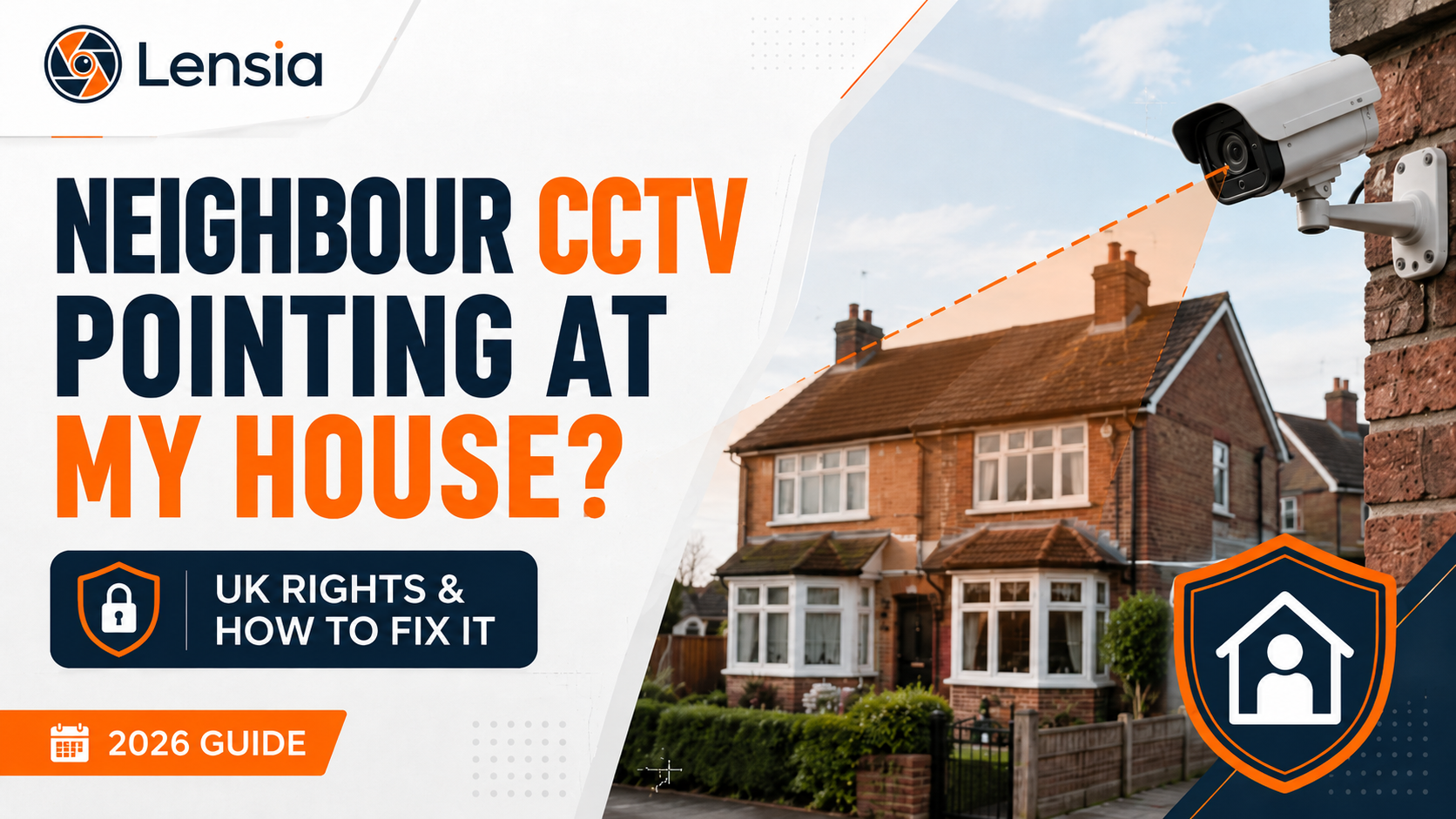
Neighbour CCTV Pointing at My House? Your Essential UK Rights Guide (2026)

Worried about a neighbour CCTV pointing at my house? You are not alone — it is one of the most common privacy questions homeowners in the UK ask. The short answer: your neighbour can have CCTV, but the moment their camera films your home, garden or the public street, UK data protection law kicks in and they have legal duties to follow. This 2026 guide explains your rights, what the law actually says, and exactly how to fix it — whether the camera is theirs or yours.
Quick answer: A neighbour’s CCTV that only films their own property is legal and unregulated. But if it captures your property, a shared space or a public footpath, they become a “data controller” under UK GDPR and the Data Protection Act 2018 — and they must have a clear reason, put up signage, store footage securely, and delete it regularly. If they refuse to comply, you can complain to the ICO.
Key takeaways
- Your neighbour is allowed to install CCTV to protect their own home.
- If their camera only films inside their boundary, no data protection law applies.
- If it films your garden, your windows, a shared driveway or the street, UK GDPR and the Data Protection Act 2018 apply.
- At that point they must justify it, signpost it, secure the footage and respond to requests.
- Persistent, targeted recording can amount to harassment — a separate criminal matter.
- The official route for a dispute is: talk first, then complain to the ICO; police only if there is harassment.
Can a neighbour’s CCTV pointing at my house ever be legal?
Yes — and this is the part most people get wrong. There is no law that stops your neighbour owning a security camera. The question is never “are they allowed CCTV?” but “what is the camera capturing?” The law draws a single, simple line: the boundary of their property.
Scenario A — the camera only films their own property (legal)
If a camera or smart doorbell is angled so it only records your neighbour’s driveway, front door or garden, it is treated as purely domestic use. Under the ICO’s guidance this falls outside UK GDPR and the Data Protection Act 2018, so there are no special rules to follow. You generally cannot object to this.
Scenario B — the camera films your home, a shared space or the street (the legal trigger)
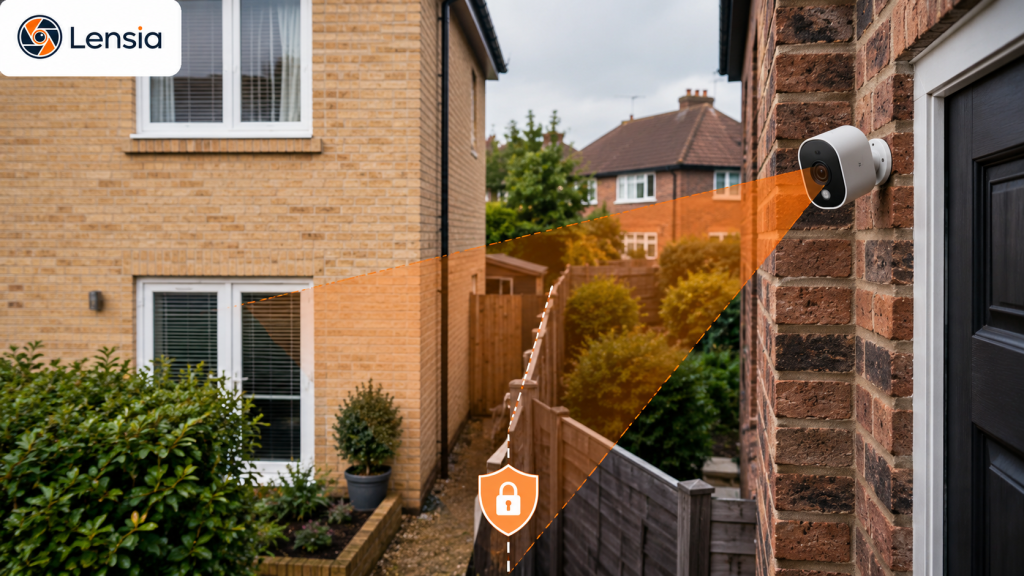
The moment the camera captures images of people beyond their boundary — your front or back garden, your windows, a shared driveway, or the public pavement — the domestic exemption disappears. Your neighbour instantly becomes a data controller and must comply with data protection law. This is the situation that gives you rights.
What the law requires when a neighbour films beyond their boundary
Once a neighbour’s CCTV records outside their own property, the Information Commissioner’s Office (ICO) expects them to meet a clear set of duties. In plain English, they must:
- Have a genuine, proportionate reason for the recording (for example, deterring break-ins or vehicle theft) — not just to watch you.
- Display clear signage letting people know CCTV is in operation.
- Store footage securely and limit who can access it.
- Delete footage regularly or automatically rather than keeping it indefinitely.
- Respond to a request from anyone caught on camera who asks for a copy of their footage (a “subject access request”).
- Stop recording you if you object and there is no legitimate reason to continue.
The ICO also advises pointing cameras away from other people’s property where possible, and using privacy filters to blur or block out areas the camera does not need to see. Failing to comply can lead to ICO enforcement action and, in serious cases, a civil claim for damages.
What about Ring, Nest and other doorbell cameras?
Smart doorbells are treated exactly the same way as traditional CCTV. A doorbell that only captures the owner’s doorstep is fine. But because most doorbells have a wide field of view, many also record the pavement, the road and parts of neighbouring properties — which brings them under data protection law. If your neighbour’s doorbell films well beyond their door, the same duties above apply to them.
Can a neighbour record audio as well as video?
Audio recording is considered far more intrusive than video, and the ICO strongly discourages it for domestic systems. Most home cameras should have audio switched off unless there is a specific, justified need. A camera that records conversations in your garden is much harder to justify and much easier to challenge.
What to do if your neighbour’s CCTV is pointing at your house
The official guidance is to resolve things in steps, starting with the least confrontational option. Here is the order to follow:
- Talk to your neighbour first. Many people simply do not realise their camera overreaches. A calm conversation often solves it — they may just need to re-angle the camera or apply a privacy mask.
- Gather evidence. Take dated photos of where the camera is mounted and what it appears to cover. Keep a record of any conversations or messages.
- Put it in writing. A polite letter or message asking whether they are filming beyond their boundary, and requesting they adjust it, creates a paper trail.
- Try mediation. If talking does not work, a neighbourhood mediation service can help before things escalate.
- Complain to the ICO. If the camera genuinely films your property and your neighbour will not cooperate, you can raise a concern with the Information Commissioner’s Office, which regulates domestic CCTV disputes.
- Contact the police only if the behaviour amounts to harassment, stalking or intimidation (see below).
- Court action is a last resort and is best taken with legal advice.
When does CCTV become harassment?
If a camera is being used deliberately to monitor, intimidate or target you — rather than to protect property — it can cross into harassment under the Protection from Harassment Act 1997. That is a separate matter from data protection and can involve the police and the courts. A single overreaching camera is usually a privacy issue; a campaign of targeted recording is potentially a criminal one.
How to set up YOUR own CCTV legally (so you never become the problem)
This is the part most articles skip. If you are installing cameras, a few simple choices keep you fully compliant and on good terms with your neighbours:
- Mount and angle for your boundary. Position cameras to look down and inward across your own land, not outward across the fence.
- Use privacy masking (privacy zones). Almost every modern recorder lets you “blank out” parts of the image — a neighbour’s window or a stretch of pavement — so the camera physically cannot store that footage. This is the single most effective compliance tool.
- Turn audio off unless you have a clear reason for it.
- Put up a small CCTV sign if any view extends beyond your property.
- Set sensible retention (for example, auto-delete after 30 days) instead of keeping footage forever.
- Talk to your neighbours before installing. A two-minute conversation prevents most disputes.
If you want a system designed to cover your property properly without straying into a neighbour’s space, the camera type and lens matter. Our guides on IP CCTV vs analogue CCTV and Hikvision vs HiLook explain how to match the right kit to your layout, and our ColorVu night vision guide covers low-light coverage.
What’s changing in 2026?
UK data protection rules are evolving. Following the Data (Use and Access) Act 2025, the ICO has been reviewing parts of its surveillance guidance, so some details may be updated through 2026. The core boundary principle — domestic use is exempt, filming beyond your boundary is not — remains the foundation. Always check the official ICO page for the latest position before acting.
Frequently asked questions
Can my neighbour point a CCTV camera at my house in the UK?
They can own CCTV, but if the camera captures your property, a shared space or the public street, they must comply with UK GDPR and the Data Protection Act 2018 — including having a valid reason, displaying signage and deleting footage regularly. If they will not comply, you can complain to the ICO.
Is it illegal for a neighbour to film my garden?
It is not automatically illegal, but it does trigger data protection duties. They must be able to justify it, minimise what they capture, and stop if you object and there is no legitimate reason to continue.
Can I ask my neighbour for a copy of their CCTV footage of me?
Yes. If their camera films you outside their boundary, you can make a subject access request and they should provide footage that features you, subject to limited exceptions.
Do Ring doorbells count as CCTV?
Yes. Smart doorbells are treated like any other camera. If they record beyond the owner’s property, the same data protection rules apply.
Who do I report a neighbour’s CCTV to?
For privacy concerns, the Information Commissioner’s Office (ICO). For harassment or intimidation, the police. Try to resolve it directly with your neighbour first.
Need help getting your own CCTV set up the right way?
Staying on the right side of the law is mostly about correct camera placement and privacy masking — both of which a good installer handles for you. Lensia Connect puts you in touch with trusted UK CCTV installers who can design a compliant system for your property, or get in touch with us for advice.
Official sources & further reading
- ICO – Domestic CCTV systems: guidance for people using CCTV
- GOV.UK – How to resolve neighbour disputes
- Data Protection Act 2018 (legislation.gov.uk)
- Protection from Harassment Act 1997 (legislation.gov.uk)
- House of Commons Library – Home CCTV systems and data protection law
This article is general information, not legal advice. For advice on your specific situation, contact the ICO or a qualified solicitor.

One thought on “Neighbour CCTV Pointing at My House? Your Essential UK Rights Guide (2026)”
Comments are closed.